More Talking Less Walking


New Listing for David Clarke and History Walks Talks

Medway Speakers List

All my History Walks Talks are now listed under ‘David Clarke’ on the Medway Speakers List.

  • 1066 – King Harold’s March from London
  • Three Castles and an Ironmaster’s House – a walk around the history of the High Weald
  • The Saxon Times – A Newspaper’s Review of 1066 (1066 in 66 minutes)
  • 1066 William’s March on London
  • Explore St Leonards on sea

A downloadable leaflet giving a description of all the talks and individual talk sheets for distribution are available at:  History Walks Talks

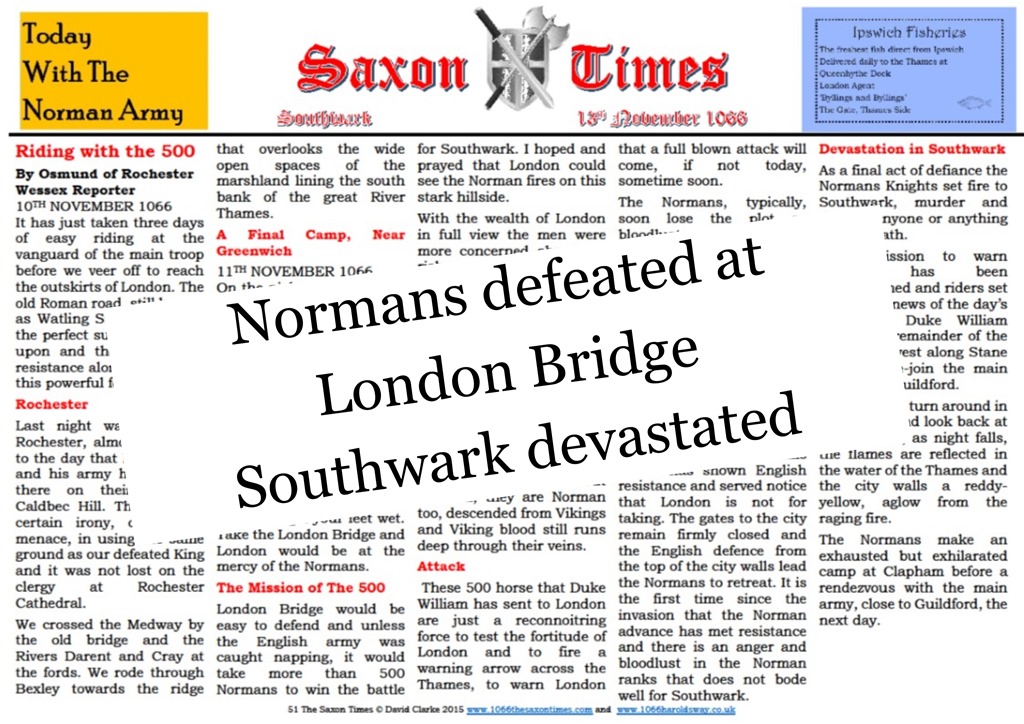
Rochester Spared but Guildford Burns.

Saxon Times Review November 1066

Get an insight into 1066 and experience the Norman Conquest through the eyes of the Saxon Times reporters. For all the stories behind the headlines read the Saxon Times.

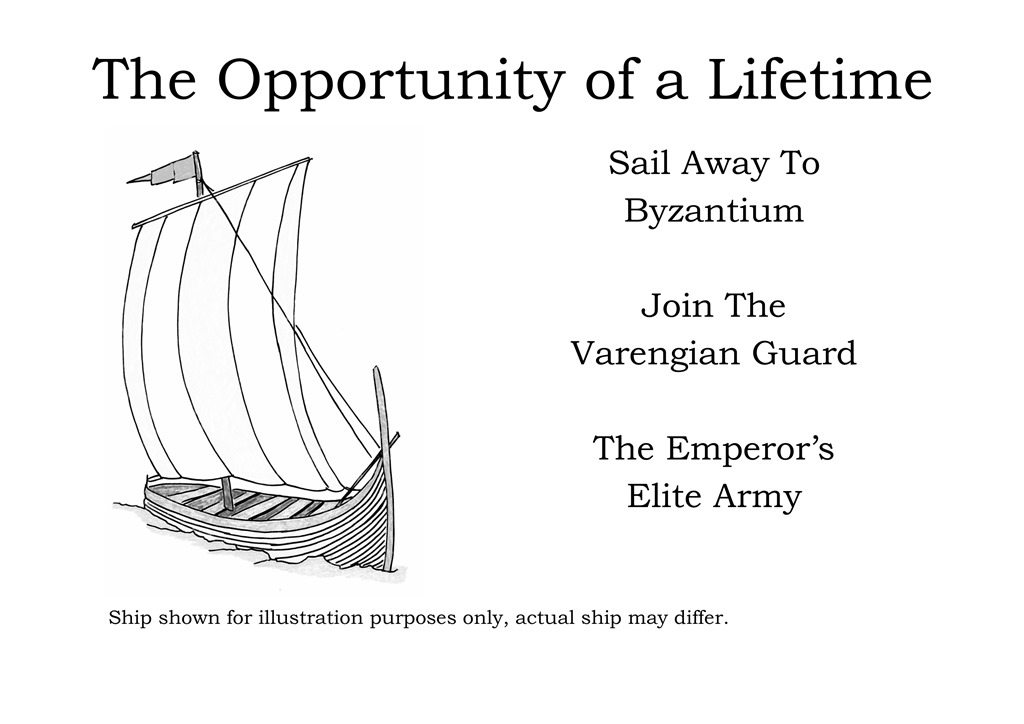
65 13 Nov Advert Varengian Guard v4

Rochester Spared but Guildford Burns

Queen Edith pledges support for Duke William and Winchester is saved

Today, Duke William sent word to Winchester, held in dower by Edith, widow of King Edward, with a demand that they pay tribute.

It was revealed in a statement from the Duke’s camp that he “considered it would be dishonourable if he went to take away the seat thus granted her and he asked for only an impost and a pledge”. This had already been agreed with the Queen’s advisers and the town council the night before. It was to be a token that safeguarded Winchester and secured the Treasury for Duke William.

The Norman War Machine moves on to Reading and Wallingford.

The army has orders to waste the countryside partly for food and partly retribution against Saxon Wessex. At Wallingford they are to make camp and wait for the Duke at the head of the enlarged Second Division

Empire To Last For Thousand Years

I listened as Duke William gave a rousing and impromptu speech from his saddle:

“Prepare yourself for the battles ahead for you will be part of a new model army that will, if necessary subdue this nation by force. We will create a Norman Empire that will stretch across Europe and last for a thousand years. We have already made great inroads in Sicily and Southern Italy and soon England will fall.

You will cherish this moment forever and soon you will take your share of our glorious inheritance”.

It was met with enthusiastic cheers but they were soon quietened as the Duke impressed upon them the need to first take Mass as befitted a Holy Army marching under the Papal Banner.

Such lies and duplicity! But the propaganda that is broadcast as part of the Duke’s war machine is readily absorbed by those with avarice and greed all too evident.


For more information on The Saxon Times visit: www.1066thesaxontimes.com/home

Normans Rebuffed at Gates of London

The Valiant Battle of Southwark

It was a valiant effort that much cheered the volunteers atop the city walls.

Issue 51

Duke William may have hoped to seize the city by surprise, or it may have just been a diversionary tactic but in the aftermath of the so called “Battle of Southwark” the heinous Normans, true to form, sacked and burnt Southwark.

By the morning, the fires had died and the Normans had gone.

This excerpt is taken from the pages of The Saxon Times, Newspaper of the Year, 1066 and is included in The Saxon Times Resource book of downloadable resources.

www.1066thesaxontimes.com

Duke William’s ‘Grand Invasion of England’

x La Bataille v4 symphony

Travel News

THERE are likely to be severe delays on all roads in the southeast, for the next three months, as Duke William continues his invasion of England. The official advice is to postpone your travel arrangements unless it is absolutely necessary as all travel is likely to prove dangerous to your well-being.

Hastings.

The news from Duke William’s advisers is that he expected the homage of the English Witan but this submission has not arrived, and that piques – one in the Norman eye for William.

William of Poitiers, his chronicler, was heard to say “When he found that they would not come to him, he decided to use all the force that was left in Hastings and that which would come to him from over sea, to ravage all the country that he overran.”

First Division The Main Army

The First Division will form the main Norman Army and march first north to Senlac Hill and then will follow the ancient trackways and Roman roads east towards Dover before moving on to Canterbury.

It is a circuitous route as it must avoid the Appledore Estuary, that great inland sea that stretches almost all the way to Tenterden. The objective is to secure Dover and start the building of a Castle before moving off towards Canterbury.

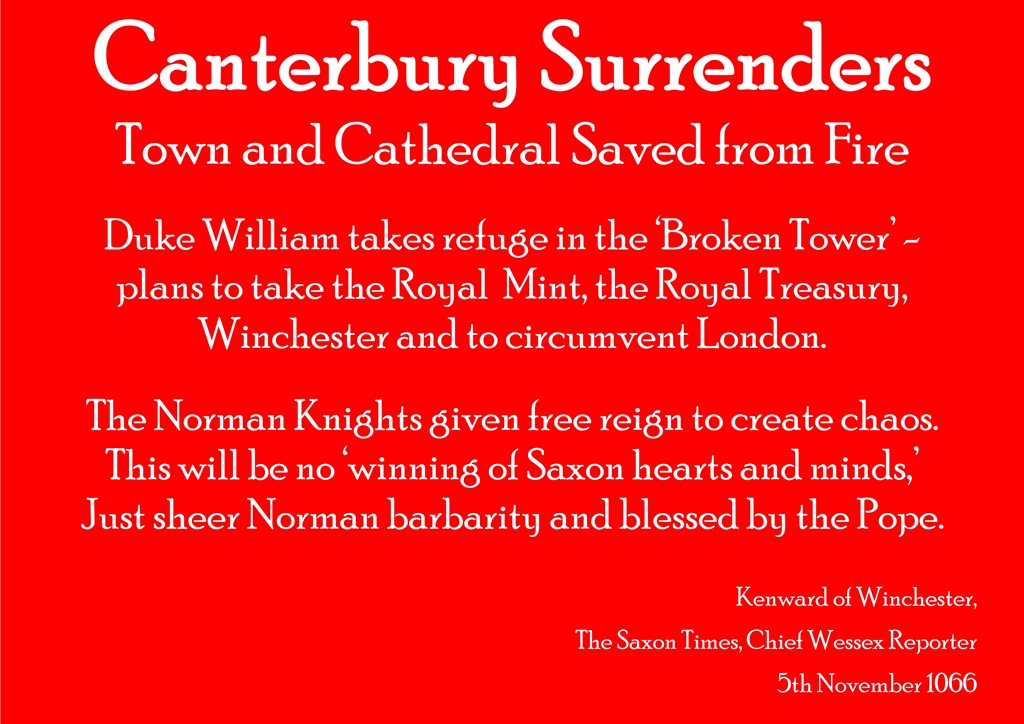
I have it on good authority that it is the Duke’s intention to negotiate the surrender of Canterbury, safeguarding the Cathedral where he intends to pray for redemption and the blessing of the remainder of the campaign.

Second Division

The Second Division will leave Hastings and march west to the great harbour at Portchester, at the head of Fareham Creek. Their orders are to seize the Royal Mints at Steyning, Arundel

and Chichester, survey and list sites for fortification that will secure Duke William’s control of Wessex that was once the stronghold of Harold Godwinson.

Barons such as William de Warenne also see it as an opportunity for personal gain, identifying lands that that they will petition the Duke for once he becomes King. With the prospect of rich pickings further west they begin to look and strut like Norman invaders and are eager to leave the confines of Hastings.

Once at Fareham Creek, they are to rendezvous with reinforcements sailing from France and Normandy. After a period of assimilation, the enlarged Division is to move north towards Winchester, making camp at Alresford and wait for further instruction from the Duke William himself.

It is stressed very forcibly, that they must not make any move on Winchester itself.

For the stories behind the headlines and the latest news on Duke William’s ‘Invasion of England’ read The Saxon Times.

The 1066 Saxon Times Resource book is a compendium of all the leading stories of 1066 available as a downloadable and photocopiable classroom resources, including quizzes to test your knowledge, and is available from The Saxon Times and TES.


The Saxon Times

TES

1066, A Tumultuous Year

Get the stories behind 1066

Books

Be informed on the news that matters

The Saxon Times brings you all you need to know about everything 1066.

More than a newspaper it’s a comment on all the tumultuous events as they happen with latest news, breaking news and current news from around 1066.

Get all the big headlines, analysis and opinion on the stories that matter.

Now available as ‘The 1066 Saxon Times Resource Book’ with 67 downloadable classroom resources covering the whole year from the Consecration of West Minster Abbey to New Year’s Eve 1066 when Duke William can be found hiding in a nunnery in Barking!

The 1066 Saxon Times Resource book is available as a downloadable and photocopiable classroom resource, including quizzes to test your knowledge,

and is available from The Saxon Times and TES.

The Saxon Times                                      TES

www.1066haroldsway.co.uk

Saxons Count Cost Of Joining Europe

Issue 40

Norman Lies

God came in peace and Bishop Odo’s reliance on the Pope’s Blessing is hypocritical at the very least.

It is really all to do with power, the power of the Church and the power of Duke William. Both see the opportunity for riches and wealth. I’ve already heard the nobles carving up lands for themselves and looting and murder are all part of their game. No doubt they hope to buy their forgiveness, in the eyes of the Lord, by making large donations to the Church.

There is no such thing as Norman goodwill.

All Are Dead

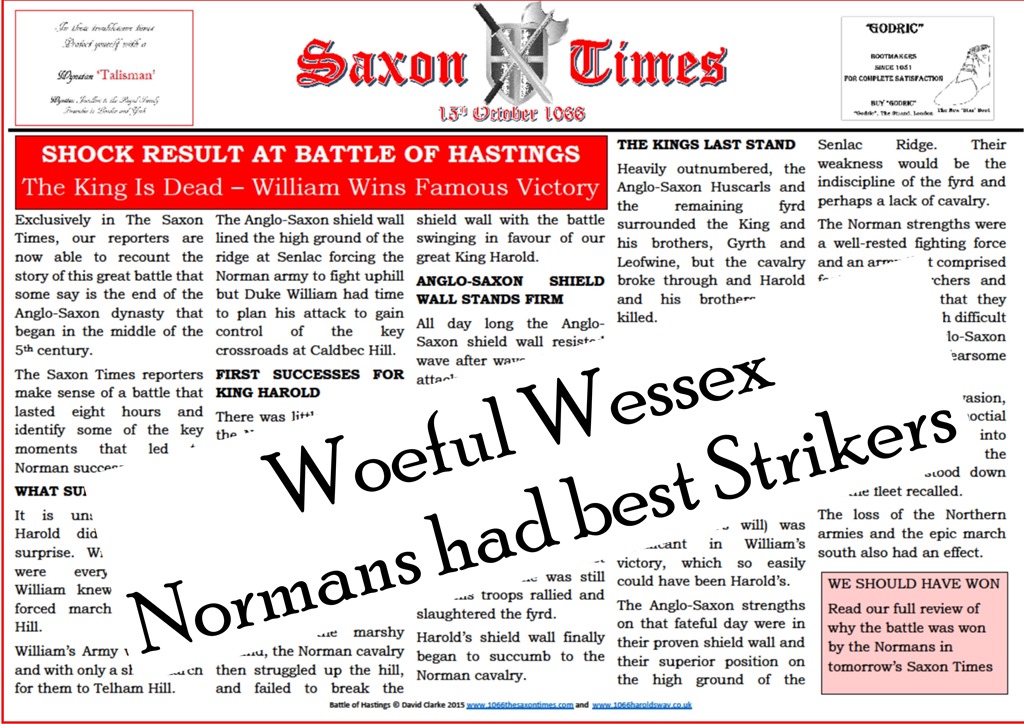
After the terrible events of the Battle of Senlac Hill, when the ‘flower of English nobility and youth lay dead’, the Norman Army spent yesterday scouring the battle field.

If any Saxon was still alive it was a miracle, but they would not be long for this world. The murderous Normans made sure that no Saxon should ‘suffer’ a lingering death.


This issue of The Saxon Times is included in the 1066 Saxon Times Resource book:

www.1066thesaxontimes.com

Final Battle Edition

Issue 39

Exclusive Eye Witness Reports

The Battle

They were like dogs after a hare- – Once they got the scent.

There was no stopping them.

Down the hill they ran, Faster And faster.

They thought that they had won. They thought that they were proper soldiers

But they just didn’t listen.

We could see what would happen From the top of the hill.

We knew what would happen At the bottom.

They gave William the upper hand As we fell back to defend the King.


Runners told us the Second Army was close But the King was hit, his brothers too

And the word was given. Fall Back, Fall Back, To the Andreasweald, To the Malfosse.


The Malfosse

It’s late. It’s dusk. The Second Army’s here. At last.

We join the line they’ve formed At Malfosse, at Malfosse we whisper.

It’s darker now And on the Normans come

The sound of horses and cries in French, Louder, Louder. Closer, Closer


They are the dogs now after the hare, They have the scent of blood.

We are stronger now and we stand defiant. We urge the Normans on For we can win here

For we can win, or we have Malfosse!


And win we did. In the name of Harold and Saxon England.

Horses and Normans piled high in the ditch. The ditch that was Malfosse.

And then we disappeared, Into the night, Into the Andreasweald.

Remember Malfosse, A victory, but a hollow one,

For we have lost our King. For we have lost our country

May God Speed And Save Us All From Norman Rule.


This issue of The Saxon Times is included in the 1066 Saxon Times Resource book:

www.1066thesaxontimes.com

God and Right are on Our Side

Issue 38

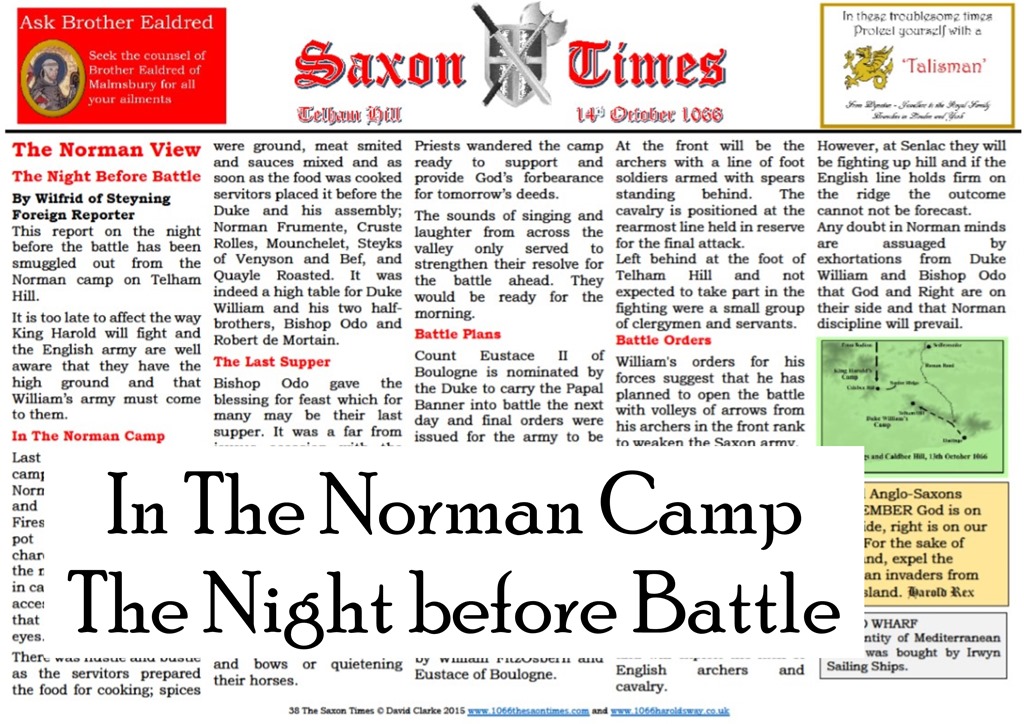
Battle Orders

William’s orders for his forces suggest that he has planned to open the battle with volleys of arrows from his archers in the front rank to weaken the Saxon army.

The infantry will then engage in close combat to create openings in the Saxon lines which could be exploited by a cavalry charge.

The Saxon lines would be broken and the cavalry would be free to pursue the fleeing soldiers.

It was a tried a tested plan that had worked in France.

It will exploit the lack of English archers and cavalry, but at Senlac they will be fighting up hill and if the English line holds firm on the ridge the outcome cannot not be forecast.

Any doubt in Norman minds are assuaged by exhortations from Duke William and Bishop Odo that God and Right are on their side and that Norman discipline will prevail.


This issue of The Saxon Times is included in the 1066 Saxon Times Resource book:

www.1066thesaxontimes.com